
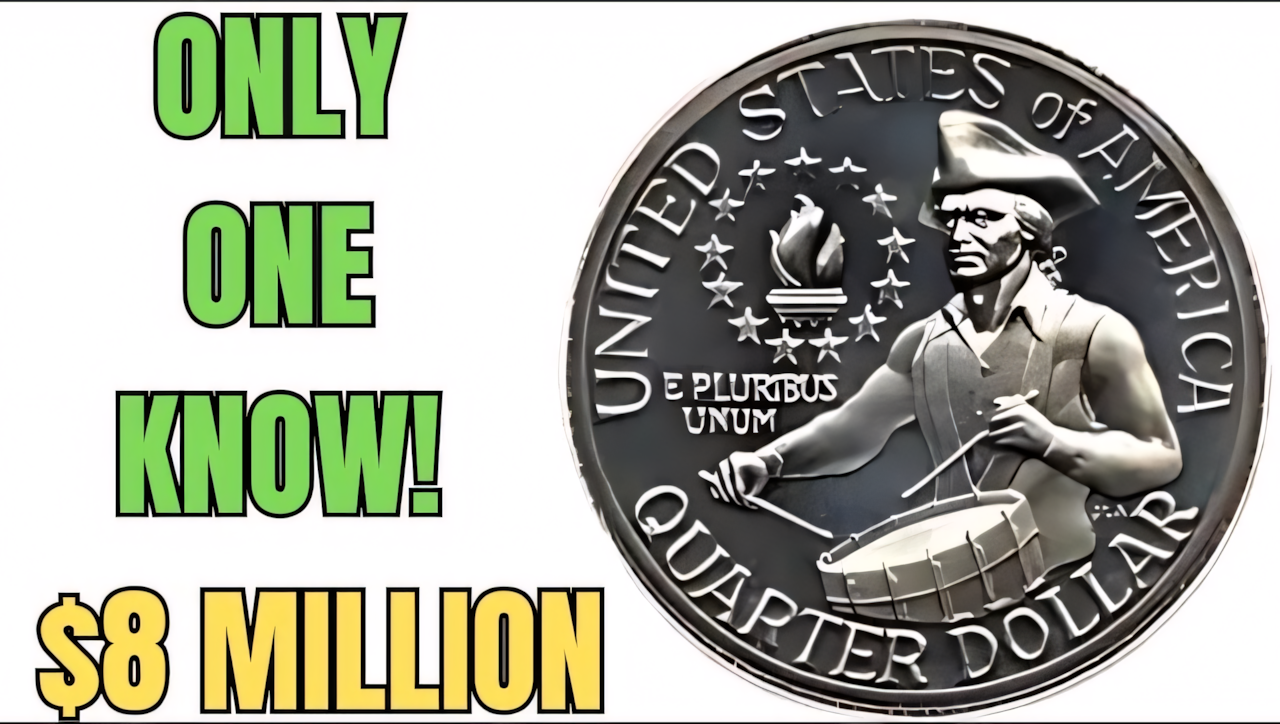

🤑 Can a Bicentennial Quarter Really Be Worth $8.2 Million?
At first glance, a Bicentennial quarter looks ordinary. Many people still have them tucked away in drawers, jars, or old collections. But one extremely rare version of this coin has rewritten U.S. coin-collecting history. 👀
In 2023, a 1976-S Silver Proof Bicentennial Quarter sold for an astonishing $8.2 million, making it one of the most valuable modern U.S. coins ever recorded. 💰
This wasn’t luck or hype. The value came from absolute perfection, extreme rarity, and historic provenance.
Below is a simple, step-by-step guide explaining why this coin is so valuable — and how you can check whether your own Bicentennial quarter is special.
⭐ Step 1: Why Did This Bicentennial Quarter Reach $8.2 Million?
This coin represents the highest standard in modern numismatics. Every detail matters.
✅ 1. Perfect PR-70 Grade (Flawless Condition)
- Certified PR-70, the highest grade possible
- Only three known examples at this level
- No scratches, spots, or flaws — even under magnification
- Features a perfect mirror-finish proof surface
📌 In coin grading, PR-70 means absolute perfection.
✅ 2. Ultra-Deep Cameo Proof Contrast
- Strongly frosted design elements
- Deep, glass-like mirrored fields
- Exceptional sharpness and clarity
- Among the finest cameo proofs ever certified
✨ This visual contrast dramatically increases collector demand.
✅ 3. Extraordinary Historical Provenance
- Originated from the U.S. Mint Director’s personal collection
- First Bicentennial quarter ever graded PR-70
- Documented ownership history added massive value
🏛️ Provenance can multiply a coin’s worth, even among identical examples.
✅ 4. 40% Silver Composition
- Weighs 6.25 grams, heavier than standard clad quarters ⚖️
- Struck in 40% silver for special proof sets
- Many silver proofs were melted over time, making survivors rare
🪙 Silver content alone separates this coin from everyday quarters.
🔍 Step 2: How to Check If Your Bicentennial Quarter Might Be Valuable
Use this checklist to inspect your coin carefully.
🪙 Quick Identification Checklist
- ✅ Date: 1776–1976
- ✅ Mint mark: “S” (San Francisco)
- ✅ Frosted design with a mirror-like background
- ✅ Sharp strike and perfect centering
- ✅ No scratches, haze, fingerprints, or discoloration
- ✅ Weight: 6.25 grams (use a digital scale)
💡 Important Tip:
Proof coins usually come from original proof sets. Loose proof quarters are rare — but not impossible.
⚠️ Step 3: Important Reality Check (Must Read)
Most Bicentennial quarters are worth only face value — 25 cents.
Only a tiny number are worth serious money:
- 🏆 The three PR-70 Silver Proof Bicentennial Quarters
- 🪙 The famous 1976 “No-S” Proof Quarter
(last known sale: approx. $1.3 million)
📉 The odds are extremely small — but knowing what to look for already puts you ahead of 99% of people.
🛡️ Step 4: What to Do If You Think You Found a Rare One
If your coin shows strong proof-like qualities, do not rush to sell it.
✅ Follow These Exact Steps:
- 🧤 Handle only with cotton gloves
- 📸 Take clear close-up photos in natural light
- 🏅 Submit the coin to PCGS for professional grading
(PR-70 candidates often require $10,000+ insurance) - 🏛️ Contact Heritage Auctions for appraisal or private-treaty sale
- 🚫 Never clean the coin — cleaning can destroy most of its value instantly
✨ Final Thoughts
Finding an $8.2 million Bicentennial Quarter is like winning the lottery 🎰 — but understanding proof coins, grading standards, and rarity can still lead to discoveries worth thousands or even more.
This legendary quarter proves one key truth:
Condition, certification, and history matter far more than age.
So before you dismiss that old Bicentennial quarter…
Take a second look — it might be far more valuable than you think. 🪙💎
Leave a Reply